Wiiiiiilmaaaaa!Whoever heard of a hurricane named Wilma? Every time I heard about it, or read about it, I pictured Fred Flintstone bellowing for his wife: “Wiiiiilmaaaa!” Sad to say, the same-named hurricane showed all of the finesse and mercy of Fred Flintstone’s big clomping feet, and not his dainty wife’s.
The 2005 hurricane season left us all reeling. Hurricanes Katrina and Rita justly consumed the media’s and the public’s attention. By the time Mrs. Flintstone paid her visit to South Florida, they must have run out of interest, because we hardly heard a thing about how things were after the storm. But first-hand information eventually trickled back to me from friends and clients living in the area – despite widespread loss of electricity and other essential services, many of them had landline phone service. The power was out, gasoline was nowhere to be found, stores were empty, curfews were in place, and damage was widespread, with too-too-many blue tarps visible on rooftops from the air. Though not nearly as bad as Katrina or Rita, South Florida was hurting.
It seemed selfish to be concerned about my upcoming vacation to the Abacos (November 5-12, 2005), but I was. Our flights went through Ft. Lauderdale, and we had an overnight stay there on the return. More significantly, the boat we planned to sail,
Sunshine, was in the New River, waiting to cross over to the Bahamas, where we’d meet in Marsh Harbour.
Luckily, air travel returned to what-passes-for-normal within days. But the boat was another matter. While the boat was in relatively good shape but for being dirty, the crew could not get water, provisions, or diesel. A drive across the state yielded 9 gallons of water. A truckload of diesel was promised but delayed. In the meantime, being the consummate planner, I’d devised Plans B, C and D, just in case. Finally, at almost the last possible moment, the crew was able to get enough fuel and water to start their journey across the Gulf Stream to the Bahamas. At West End (Grand Bahama), they found devastation – the customs and immigration station closed and the marina battered. They weren’t able to clear in until reaching Green Turtle Cay. But they made it.
Take Another RoadMeanwhile, back in Maryland, Rick (“Thomas O’Foolery”) and I (“Tonya”), and our friends Skip (“Skeeter”) and Harriet (“Lulu”) (we find it important to have boat/bar aliases…), were enjoying unseasonable 70+ degree weather in Maryland as we packed our bags (50 pound per person limit) and prepared to head down island. Aside from fretting about whether Wilma has trashed our plans, I was buried under work, trying to keep up as well as getting ready to hand things off to colleagues for the week.
Rather than our conventional American Airlines routing through Miami to Marsh Harbour, we were flying to Fort Lauderdale via Air Tran, and then switching over to commuter carrier Calypso/Twin Air. This, my first experience with Air Tran, was remarkably smooth. I especially liked the $50 upgrades to Business Class, which we took advantage of both ways. Though not exactly the first or business class of the olden days, the $50 buys you a larger seat up front, and first dibs on drinks and cookies; considering that I’ve paid $35 a pop to get upgraded to Economy Plus on United (a little bit more legroom in a coach seat), this was a good value.
Though we’ve flown a lot of small commuter airlines in our travels, this was our first time to catch a flight outside of the main airport. After killing some time in the main terminal, we took a taxi to Twin’s building on the north side of the airport and boarded the twin engine Cessna right on time, being seated in the tiny plane (I had to straddle Rick’s seat in front of me) by weight. As always, the views of the islands from above were spectacular, and our pilot set us down gently at MHH, where we moved quickly through immigration, collected our bags, passed through customs, and headed outside into the soft Bahamian air.
If the trip eastbound was easy, the return back to Florida was even easier, and convinced me that flying small commuters to the Out Islands is the only way to go. Check in at Marsh Harbour was extremely painless, and when it was time to leave (a bit early), the gate agent found us outside and walked us to the plane. We left early, and with a mighty tailwind, arrived at Ft. Lauderdale 40 minutes ahead of schedule. Arrival at the Jet Center was smooth, especially with a dedicated customs and immigration station for a mere 7 of us. After this experience, I don’t think I ever want to go through the insanity that is re-entry in the United States at MIA, with the crush of hundreds of arriving passengers.
Rick and I are dedicated bareboaters. That is, when we sail boats in the islands, we serve as our own crew. Our friends Skip and Harriet haven’t sailed down island as often as us, but like us, sail their own boat (both of us own Sabre 38s) in the Chesapeake for many weekends, and weeks, during our sailing season. This time, however, we were going the “captained” route. Basically, the new, luxurious boat we were to sail was only available to us with the owner on board. Not that we minded, because our “skipper” was our acquaintance of many years, Mike, who would be joined for a few days by his partner, Margaret, so it was nothing more than sailing with friends for a week.
Our ship was a 1-year-old Manta 42 catamaran. It had two large aft cabins in each of the hulls, with comfortable queen-sized (if not bigger) berths, and a third cabin forward in the starboard hull (equipped with a washer-dryer!). The main head (in the port hull) was positively luxurious, with an electric freshwater head and a full-sized stand-up curtained shower (though we, being sailors used to conserving fresh water, didn’t use the shower as much as we used the hose on the swim steps). The galley was comfortable (though still a One-Butt) and well-equipped, with a cavernous (in boat terms) top-loading freezer and refrigerator. Since this was not a charter boat per se, the kitchen equipment was much better quality than your standard Moorings boat, and my co-chef and I absolutely reveled in the sharp knives and high-grade cookware. The cockpit was huge, ideal for lounging and dining and drinking; and if a change of scenery was required, there were always the trampolines.
Sunshine was set up for virtually push-button operation. There is only one winch, an electric Harken, and all the lines were led to the helm station. You raise the oversized main or the self-tacking jib with the push of a button; you raise the anchor with a push (by toe) of the electric windlass control. Though Mike could operate the boat himself with this set-up, we all helped.
The Weather Is Here, I Wish You Were BeautifulThis was my fifth trip to the Abacos. If you’ve followed my adventures (many of which can be found on my webpage,
www.homestead.com/islandtime/MainPage1.html), you know that most of my travels have been challenged by weather woes. Some of them are just plain bad weather, like the Abaco trip of 2002 during which it rained the entire time (
http://www.homestead.com/islandtime3/Abaco02Part1.html), or the other trips, which were bedeviled and chilled by cold fronts. Other times are more dramatic, like hunkering down in the BVI during Hurricane Georges in 1998 (
http://www.homestead.com/islandtime2/bvi98part1.html) or spending days marooned in Dallas on our return from Belize due to a massive East Coast snowstorm (
http://www.homestead.com/islandtime3/Belize03Part1.html). They don’t call me Typhoon Tonya for nothing. Needless to say, with my experience, I viewed Hurricane Wilma as a harbinger of things to come.
Thankfully, I was wrong. The weather during our week was the stuff of tourism brochures. High temperatures each day around 80, with overnight lows in the 70s, with enough nighttime breeze to require us to sleep with blankets. During the day, the sun shone on us, and the wind propelled our boat at a smart clip, often reaching 8 or 9 knots. We listened to the weather reports on the Cruiser’s Net (8:15 a.m. on VHF 68) daily, and got nothing but good news. Even the cold front passing through on Thursday was a dry one, freshening wimpy morning breezes into a firm 20 knots by lunchtime. The water temperature was perfect for refreshing swims, not so cold that you dread jumping in, but no so warm that it feels like a bath.
Of course, it truly is the luck of the draw. While many people claim November is the best time of year to visit Abaco, weatherwise, it doesn’t always work out. In 2001, we had planned to sail the first week of November. Instead, a hurricane (Michelle) was planning arrival for the same day as us, and we diverted to the BVI, re-booking Abaco for the following year (which was the rain-drenched trip noted above). This time, luck was with us.
The Livelier Pleasures of AbacoFor me, the measure of a good cruising destination is variety. While I crave solitude and seclusion at times, days on end would be tedious. A little low-key action is welcome to break it up. The British Virgin Islands used to have the ideal mix, but the incursion of cruise ships – sometimes several a day – has changed the chemistry; now even the secluded spots are less so, as those seeking to escape the hordes are flocking to the once-quiet spots, crowding them. The Abacos still have it right, though it helped that we arrived just as places were opening up for the season.
Upon arriving on Saturday at MHH, we met
Sunshine and Mike and Margaret at the Moorings marina at the Conch Inn. While our late afternoon arrival would have left us in port as bareboaters (especially since it was now getting dark at 5:30), Mike’s knowledge of the waters allowed us to head straight for where the Abaco-style action was. With absolutely no ado, we dropped bags in our bunks, exchanged hugs and introductions, and by 5 p.m. were motoring towards Fisher’s Bay on Great Guana Cay, the anchorage which is just north of Settlement Harbour. I made a quick reconnoiter of the galley and provisions, and served up drinks in time for us to watch the sunset.
We had a too-leisurely dinner at the Blue Water Grill, with easy-flowing conversation punctuated with laughter, the way it would go all week. We conched out shortly after returning to the boat. But we were just storing up energy for the main event – a first for all of us – Nipper’s Pig Roast on Sunday.
Sunday was our first morning on the boat and reminded me of some of things I love about Abaco. I was one of the first awake, at first light, and I sat in the cockpit taking stock. The only sounds were the not-so-distant roar of the ocean just over the narrow spit of land off which we were anchored, and the closer slap of wavelets against our hull. The air was soft and warm, and the sun was slowly brightening the sky. We were slow to move, but there was no hurry anyway. Rick and I circumnavigated Delia’s Cay in an inflatable kayak, unable to gauge depth since the bottom is as clearly visible in feet of water as it was in inches. Finally, we were ready to go ashore.
One of Wilma’s casualties was our dinghy. Between the storm’s ravages and the Gulf Stream crossing, its carburetor had been fouled (perhaps by dirty fuel, perhaps by wind-driven debris). No matter: we had strong men to paddle us ashore, though we chose to land closer to the boat than to our destination – at the Dive Guana dock rather than the Guana Beach Resort dock. That meant a longer walk to Nipper’s, but we cut through Dolphin Beach Resort to reach the beach and walked over along the shore.
What can be said about Guana’s oceanfront that hasn’t already been said more eloquently by others? The water runs the gamut of blues and greens, and the surf foams up onto a creamy sand beach. Here and there, rocks and ironshore punctuate the shore, and a few houses ride high on sea oat covered dunes. A bit further south, up a weathered staircase, Nipper’s presides in a profusion of color. When we arrived after 11 a.m., a lively but mellow crowd was starting to gather, so we claimed a picnic table (painted in turquoise, hot pink, orange, and blue) and bought our tokens for lunch. I limited myself to one frozen Nipper (a variation of the classic rum and fruit juice combinations throughout the islands), and then joined the others in drinking Kalik, the elixir of the Bahamas.
The pig roast was just about the best meal we ate all week, and definitely the best value (at $20 per person). And the atmosphere at Nipper’s (albeit early in the season) was lively and entertaining, with lots of people to talk to and scenery to take in, without being overcrowded. The location is perfection, and we ranged between jumping in the ocean and body-surfing, dipping in the two-level pool, and just hanging out at our table. I loved talking to people at Nipper’s without even exchanging names, and then running into them later – say at Miss Emily’s Blue Bee Bar on Green Turtle Cay – as if we were long-lost friends.
By late afternoon, we were back aboard
Sunshine and enjoying a superlative sail back to Marsh Harbour, where we would see Margaret off to Toronto the next morning and have our dinghy motor tended to by Terrence. None of those tasks took very long, and by late morning we were on our way again – this time to another favored party spot, Pete’s Pub in Little Harbour.
Little Harbour is the Abaco equivalent (in many ways) of the BVI’s Bitter End. Here is the last truly sheltered anchorage of the Abacos, as the string of offshore cays tails off at Lynyard Cay and any further sailing south is in open ocean down to Eleuthera’s northern satellites – Harbour Island, Spanish Wells and Royal Island. And something about that land’s end location inspires the birth of a watering hole with real character. My past misadventures at Pete’s Pub are chronicled here:
http://www.homestead.com/islandtime/Abaco5.html.
Sadly, my fuzzily remembered day at Pete’s Pub was not to be reprised on this trip, and I would hang on to both of my shoes this time. This early in the season, the pub was open only during the weekends, so we contented ourselves with a quick stroll through the empty pub and Pete’s gallery (which his daughter-in-law kindly opened for us) and collecting sea glass on the ocean beach.
Most of the rest of our Abaco bar visits were similarly low-key, including a stop at Miss Emily’s in New Plymouth, drinks at the Jolly Roger bar at the Bluff House on Green Turtle Cay, and ocean front libations at the Hopetown Harbour Lodge. Luckily, our crew was a happily self-contained group, and we were just as happy entertaining ourselves as we were in the company of others.
As a bookend to our trip, we also spent our last full day (Friday) at Nipper’s. I guess I looked like I had a good time, because the next morning everyone asked me “Are you OK?” And I was! Why would they think otherwise? Was it the shoe (always the shoe thing…) I lost while boarding the dinghy back to the boat? (Thank goodness it floated and was retrieved; I had only brought the one pair of Keen sandals with me on this trip and would have been limping home without it….).
We had arrived at Nipper’s on Friday in the early afternoon after crossing over from Green Turtle Cay via the Don’t Rock passage. After lunch aboard, we hit the beach and the bar and the pool, whiling away a gorgeous part of the day. The surf was kicking, the water was warm, and the mood mellow. We returned to
Sunshine for showers and sundowners, only to return to Nipper’s for dinner and more frozen Nippers (which, admittedly, were devolving into “frozen nipp..s” …). A perfect Friday.
WatercolorsAbout 10 years ago, one of my partners asked me to help him plan an island getaway for him and his wife, his first visit to the Caribbean. Carefully listening to their interests and wishes, I suggested they go to St. Croix, which they did. When he came back, he told me that he was amazed by the colors of the water. He’d believed, until then, that all the photos of those amazing crystalline blues of the Caribbean were doctored.
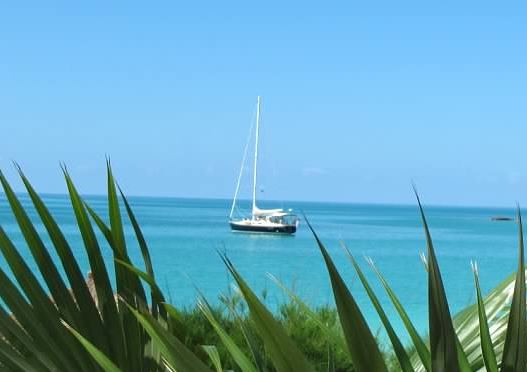
Yet, even if you believe the photos real, nothing prepares you for the reality of that color of water except, perhaps, having seen it before. And nowhere are those colors more vivid than in the Bahamas. They glow with life, bathing everything around them with their otherworldly hue. That special Abaco blue is most obvious and prevalent over the sand banks and bars which create hazards for unwary navigators in the Sea of Abaco.
The sandbar extending from the west side of Lubber’s Quarters Cay has that glassy, blue-green sheen. But that is only a waypoint enroute to my favorite Bahamian sandbar: the Tilloo Bank. The Tilloo Bank extends a mile or more from the west side of Tilloo Cay into the Sea of Abaco, with a white sand bottom and a depth of no more than 10 feet. The turquoise waters appear from a distance like a glowing smudge, lit from within; when you are over the Bank, it shimmers like a aquamarine gem having orange inclusions in the form of giant starfish.
Although Mike had warned that the hurricanes of past years had decimated Tilloo Bank, I was hot to make a return visit. So, on Tuesday, after overnighting in Little Harbour, we headed north to Tilloo Cay and tucked
Sunshine into a 4 foot deep spot near the northwestern corner of the Bank. Soon, armed with snorkel gear and mesh bags, we were in the water. While the Bank itself is a swimmer’s dream – a giant swimming pool -- it’s the edges that hide the booty: lying in the grassy fringes of the sand bank are sand dollars and sea biscuits galore.
The pickings weren’t as rich as in the past, so perhaps the storms had indeed taken their toll. And my technique leaves a bit to be desired, especially in deeper water. I take a deep breath and dive down seeking my prize, but invariably, I’m either too excited or running short of breath and I end up crushing my intended target with my overzealous hand. Nevertheless, enough pristine specimens made it out of the water to have made it worth our while.
Another one of the Abacos’ remarkable sandbanks is the Don’t Rock passage. To those who aren’t familiar with this area, the cays offshore of Great Abaco run roughly north to south, creating a protected, if somewhat shallow, cruising ground. At a point just north of Great Guana Cay, opposite Treasure Cay on the “mainland,” the Sea of Abaco becomes extremely shallow, an area of shifting sands which most boats cannot navigate because they will hit bottom. Boats with deeper draft wishing to head north to Green Turtle Cay and beyond must exit the Sea of Abaco and brave the infamous Whale Cay Channel, noted for its “rage” sea conditions – the same conditions which helped spell the demise of cruise ship activity in the cays.
Rick and I had traversed The Whale on past trips, but a shallow draft boat, like
Sunshine, captained by someone having local knowledge, can take the interior passage referred to by its most notable feature, a rock known as Don’t Rock. Sailing north across the Don’t Rock on Wednesday was like flying in a haze of blue – you’re floating, hovering on a seemingly boundless sea of that famous blue of clear water over sand, while at the same time being borne by the wind. It’s a sublime experience. Our return trip over the Don’t Rock on Friday was only slightly more prosaic, made challenging by the fact that we were traversing at dead low tide, with a concern that the troughs of waves would unceremoniously deposit us on the sandy bottom. A lack of wind made it slow going, but the promised dry cold front soon picked up the wind and we were on our way.
One thing that becomes evident in the Abacos is that I simply don’t know enough words for “blue.” How many times can I say azure, turquoise, aquamarine, blue topaz, cerulean, sapphire, or lapis? To those who have visited here, “Abaco blue” is descriptive enough. To those who haven’t, all I can say is that, while the pictures don’t lie, they only hint at the splendor of the waters.
Turning TidesThe last couple of years, Rick and I have spent our November vacation on Cat Island. Our June 2002 visit to the Abacos found the cays a little busier than I’d liked, with the summer bringing lots of sportfishermen over from Florida and taking away from some of the feeling of escapism. One of the amazing things about Abaco – its proximity to “civilization” – is also a potential curse. For that reason, we found ourselves going further “out” in the Out Islands. While we hadn’t forsaken the Abacos, it wasn’t clear when our next trip would be, either.
I still kept up with doings in Abaco, and soon read about the attempts to develop the Baker’s Bay area of Great Guana Cay. Aside from the environmental, social and economic issues raised by the project, the proposed development struck me personally. My idyllic memories of those north-end beaches were being smeared, much as Hurricane Katrina wiped away a part of my youth when it devastated my college town of New Orleans. As soon as I heard about what was happening at Baker’s Bay, I resolved to return to Abaco.
Our return was too late to see Baker’s Bay as it had once been. Seeing the cranes hovering over the north end of the cay was an insult. Mike told us we could anchor in Baker’s Bay notwithstanding the construction – he and Margaret had done it just before we arrived -- but it didn’t make much sense to me to do it. I certainly didn’t want to go ashore – assuming one could – to a scarred landscape.
While the magic that was Baker’s Bay may never be recovered, I am grateful that for beach lovers like me, all is not lost, either. There are plenty of untrammeled strands; some of them might pose enough logistical challenges that they may never see development.
On Wednesday, after crossing the Don’t Rock, we anchored in Black Sound, Green Turtle Cay, with the express purpose of exploring one of those beaches: Gillam Bay. It was a bit of a hike from our anchorage, and there is no real access to the beach from the road short of cutting through someone’s yard. But Mike is so connected in the Abacos that he probably knew all the homeowners on Gillam Bay anyway. Strictly speaking, Gillam Bay is not secluded because there are a number of homes lining its shore. However, we only ran into one couple on the beach. The beach marks a mile-long crescent along shallow blue water, lined with casuarinas, then bends around corners at either end (which we never reached) into more and more beach. On this day, the wind was blowing and the water was kicked up, so the sea was more opal than topaz. Facing easterly, the beach is also susceptible to the sort of junk that washes up from the ocean. Nevertheless, we enjoyed our afternoon here.
Thursday was the highlight of our week, and salved my grief for the lost-to-me Baker’s Bay. On Thursday, after making a run into New Plymouth to buy ice and bread, we motored north for an hour to Manjack Cay. I’d never visited here before, but I daresay it was worth the wait and will draw me back for future visits.
On approach, Manjack’s beach doesn’t look much better or different from other Bahamian beaches. While there is a pretty white strand of sand bordered with feathery pines, there seems to be a lot of grass off the beach; as well, there is a dock, which takes away from the promise of escape. But we were not content to take things at face value, so we got in the dinghy and rounded the west end of the beach. There, we found our reward.
That morning, we found the western tip of Manjack Cay, at low tide, to be a broad swath of flour-like sand which extends a good distance into the water. A long, narrow ironshore islet extends northward off the tip of Manjack, and there is a sandy-bottomed creek separating the beach and the islet. To the east of the islet curves a wide, crescent bay edged with more white sand. The bottom is sandy is spots, and grassy in others, with a large area of sandy bottom at the
northeastern end of the bay, ending in a long stretch of ocean slapping against ironshore. The beach is littered with sea biscuits for the taking, as well as sea urchins galore – both dried out and still-spiny.
It was me, Rick and Harriet on the Manjack beach in the morning, as Skip had had a sleepless night and wanted to nap. But after lunch, we insisted he come with us. With the tide having risen, we were able to take the dinghy through the creek and across the bay, landing it on the wide sandy beach at the northeastern corner of the bay. This time, Rick and I had thought to bring shoes, so we braved the ironshore and walked towards the ocean. Eventually, we reached an empty ocean beach. While Rick looked for a likely snorkeling spot (he didn’t find one), I body surfed. Soon, Skip and Harriet arrived, and while the girls played in the water, Skip gathered up flotsam and built himself a chair. We later returned to the calmer bay and whiled away the rest of the afternoon on fun-noodles.
The Manjack beaches were pleasure enough, but we also had the luck of timing, arriving to the beach just as the tide was turning. When the tide turns, the larger creatures of the sea hear the dinner bell. While wading in the creek, a ray with a 4 foot wing-span floated quietly past us, coming within 5 feet of me. And a little later, we spied a sand shark at the edge of the beach, looking for its meal ticket (not us!!).
Turning tides also brought us many dolphin encounters. Usually preceded by skittering – and sometimes jumping and flying – fish, swimming to escape their predators, the turn of the tide was the time we were most likely to see the dolphins’ smiling faces. In Little Harbour, many of them frolicked around our anchored boat, and then rode our bow wave out of the anchorage. And in Fisher’s Bay was saw several as well, chasing their prey close to shore and going in for their meal. Seeing dolphins usually makes me clap my hands like an over-excited 4-year-old, but I can’t seem to help myself.
Man Cannot Live on Bread AloneMy first Out Island visit was during my first year of marriage and last year of law school. Rick and I went to Eleuthera for my spring break in 1990 (a mini-report can be found here:
http://www.traveltalkonline.com/forums/s...true#Post329857), becoming infected with our passion for the Out Islands. It was in Eleuthera where we discovered that most wondrous of Bahamian delicacies: the bread. In its most typical form, it is white bread, but it is denser and sweeter than commercial sorts of bread, and smells – simply – of yeasty nirvana. Ever since then, every memory of every trip to the Out Islands is leavened with that amazing bread – be it BLTs packed in a picnic lunch eaten on a beach, or delicious rolls accompanying conch chowder.
And so it was that we spent the early part of our trip trying to get our hands on some to provision our boat. After the pig roast at Nipper’s, we walked through the Settlement, but found none because it was Sunday. Monday’s quick stop in Marsh Harbour yielded two freshly-baked loaves, Rick having waited outside the bakery until the appointed hour of 9:30 a.m. Whether filled with salmon salad or peanut butter and jelly, or forming the base of french toast like no other, the bread – together with Kalik and rum – was a staple of our week’s diet.
Bahamian bakers are justly renowned, and it is not just for their bread. We spent a lazy afternoon wandering the lanes of Hopetown. When we stopped at Vernon’s grocery store – with the express purpose of getting more bread – we scored again. Not just a loaf of bread, but an apple spice coffee cake (which we ate for breakfast the next morning) as well as that holiest-of-holies: Vernon’s key lime pie. Somehow, we were able to control ourselves and made the pie last for two dinners. But it wasn’t easy.
With the basics of bread, rum and beer covered, we did eat well on
Sunshine. I’ve made it a tradition to make conch chowder whenever I get a chance to cook in the Bahamas, so we had that one night (and had leftovers the next day for lunch). We also enjoyed on-board dinners of shrimp stir fry and grilled tuna. Ashore, we held to Bahamian basics of conch, fish, and more conch (with the exception of pig at Nipper’s). In addition to those already mentioned, we enjoyed meals at Captain Jack’s in Hopetown, Pineapple’s on Green Turtle Cay, and Snappa’s in Marsh Harbour. But it all comes down to the bread.
It’s a Small World After AllI can’t explain it, short of blaming it on the Bahamas’ being in the Bermuda Triangle, but I keep having those neck-prickling “small world” experiences whenever I travel to Abaco.
The first time I had a small-world encounter was during my second trip to Abaco – in 1997. We had so enjoyed our first trip the year before that I invited my parents to join us in a stay at Sea Spray Resort on Elbow Cay. Most days, we’d stroll south to Tahiti Beach, where we spent many an hour – passing each way a beautiful home under construction atop the cliffs overlooking the ocean. When I returned to work, I dove right into a transaction for a lovely English couple who’d hired me and my firm on a friend’s referral while I was away. Many weeks later, en route to Boston to close their deal, I was chatting with their investment banker, who mentioned casually that the clients were building a home on some obscure little island in the Bahamas. Sure enough, they were building that beautiful oceanfront home I was walking past on Elbow Cay.
Two years later, Rick and I had closed on the purchase of the first of our Sabres, a 34-footer named
Lattitudes II, just before leaving for our first sailing trip in the Abacos. While in Hopetown harbour, we spied a sistership, but found no one home. As we ended our trip, we thought of our sistership and started hatching our own plan to go on an extended cruise. Over the ensuing months, we researched and plotted. One day, while cruising the internet trying to flesh out our 5-year plan (which, incidentally, we’ve since dropped for various reasons), I found a series of logs of a Sabre 34 cruising the Bahamas – it was the very boat we’d seen in Hopetown, but now it appeared that the couple had returned to the U.S. On a whim, I sent an e-mail to them. In the course of our e-mail exchange, we confirmed not only that the couple were Annapolis-area sailors and were members of the Chesapeake Bay Sabre Association we’d just joined, but also that they lived in our development!! We decided to meet the couple for drinks, and have retained a friendship with the wife (who, not-so-incidentally, is also friends with Skip and Harriet, whom we met through the CBSA).
Given this past history, I suppose it shouldn’t be surprising that close encounters occur, but I still get a little thrill when it happens. On this trip, we had no less than three such encounters.
Not long before leaving for our trip, I exchanged e-mails with fellow sailor, sfalko, here on TTOL. He mentioned that he, too, would be in the Abacos the same week we were there, and we exchanged details. As these things go, I look forward to bumping into web-friends, but crews tend to have their own dynamics and agendas, so I rarely do anything affirmative to seek out a web-friend while traveling. After many trips to the BVI, we NEVER ran into anyone we knew. But somehow, in the Abacos, it happens. So, when we dropped anchor in Black Sound, GTC, I spied the boat in question,
Sloop du Jour, but no one was home. When we went ashore with Mike, we walked past a group of guys going the other way, one of whom asked for me. Mike’s wearing a Manta shirt tipped of them off to my possible identity. We shared a pleasant chat, then went our different ways, unplanned mission accomplished.
Before becoming a Manta man, Mike used to work for PDQ catamarans. He continues to have a keen eye for the boats, having delivered many of them from the factory to their destination or to the Bahamas. While in White Sound, PDQ, we were anchored next to one, and Mike started sharing its provenance with us. Something about the boat’s name (
Dream Catcher) and story rang familiar to me, and as I cleared the rum fog, I remembered the owners as another pair of young Chesapeake sailors gone cruising, whose exploits I’ve been following on their website. We saw the boat again in Settlement Harbour, as well as on our last day in Marsh Harbour. I dropped them an e-mail just to hello, and found out that they had met the folks on the boat next to them in Marsh.
Harriet was the first one to spot a white Bristol 38.8 in Marsh Harbour (which was next to
Dream Catcher). Unfortunately, we couldn’t see its stern and so we couldn’t make out its name, but we thought that the boat could just be
Seaquel, carrying friends George and Julie on their way to the Exumas, where they have spent part of most winters since their circumnavigation. We kept calling on the radio (VHF 16), but heard nothing. When we went into town for lunch, we carried our handheld radio with us, but got no response. As we ate lunch at Snappa’s, we saw a dinghy leave the boat, but by now had given up. And so it was that we ran into George and Julie on the street, as we were walking back to Marsh Harbour Marina! It turned out that George and Julie had learned of our plans to be in the Abacos and were trying to find us, but they were using VHF 68 – who knew? It was through dumb luck that we got a chance to get together for a little while, just as we were heading north and they were going further south.
There’s probably just some boring, rational explanation having to do with geography, and small places, and common interests, and the incestuous Annapolis sailing community … yadda yadda yadda. Frankly, I prefer to think of it as destiny, or serendipity, or even the Bermuda Triangle. All the better to maintain the mystique of this magical place called the Abacos….
Back to 16.
ItinerarySaturday, November 5Arrive Marsh Harbour
Depart Conch Inn Marina
Anchor at Fisher’s Bay, Great Guana Cay
Dinner at Blue Water Grill
Sunday, November 6Beach time on Great Guana Cay
Nipper’s Pig Roast
Sail back to Marsh Harbour
Dinner aboard (Eva’s conch chowder)
Monday, November 7Take care of boat business and send Margaret home
Sail to Sandy Cay for snorkeling
Sail to Little Harbour
Explore Pete’s Pub
Dinner aboard
Tuesday, November 8Sail to Tilloo Bank
Anchor at Tilloo, snorkel, and explore beach
Sail to Hopetown via Lubber’s/Tahiti Beach
Explore Hopetown
Drinks at Hopetown Harbour Lodge
Dinner at Captain Jack’s
Wednesday, November 9Explore Hopetown lighthouse
Sail to Green Turtle Cay via Don’t Rock
Anchor in Black Sound
Beach time at Gillam Bay
Explore New Plymouth
Drinks at Miss Emily’s Blue Bee Bar
Dinner at Pineapple’s
Thursday, November 10Quick run into New Plymouth
Manjack Cay beach time
Sail to White Bay
Drinks at the Bluff House
Dinner aboard
Friday, November 11Sail back to Great Guana Cay via Don’t Rock
Beach time on Great Guana
Pool time at Nipper’s
Sundowner’s aboard
SunshineDinner at Nipper’s
Saturday, November 12Sail back to Marsh Harbour
Pack up
Shopping in Marsh Harbour
Lunch at Snappa’s
Ice cream with friends from
SeaquelFly to Ft. Lauderdale
Stay at Doubletree Galleria
Dinner at Seasons 52
Sunday, November 13Early flight back to BWI